
Imagine this. A construction worker climbs a ladder on a busy site in Chennai. He is in a hurry — just a quick job on the second floor. He skips his harness because it takes two minutes to put on. Thirty seconds later, the ladder shifts. He falls. His helmet saves his life, but the broken arm and three-month recovery could have been avoided entirely with a properly fitted safety harness.
This is not a hypothetical. Variations of this story play out on construction sites across India every single week. Most injuries and fatalities in construction are preventable — and Personal Protective Equipment (PPE) is one of the most powerful tools we have to prevent them.
This guide will walk you through every major category of PPE used in construction, explain exactly when and why each one is required, and help you choose the right equipment for the right job.
Table of Contents
What is PPE and why does it matter?
Personal Protective Equipment (PPE) refers to any device, garment or equipment worn by a worker to minimise exposure to hazards that can cause injury or illness. In construction, these hazards include falling objects, falls from height, chemical exposure, noise, dust, electrical risks and extreme temperatures.
PPE is considered the last line of defence in the hierarchy of hazard controls. This means that eliminating or engineering out the hazard should always come first — but when that is not fully possible, the right PPE fills the gap between a worker and serious harm.
In India, the use of appropriate PPE on construction sites is mandated under the Building and Other Construction Workers (BOCW) Act, 1996 and its associated rules. Employers are legally required to provide PPE free of charge to workers. Workers are required to use it correctly.
Knowing which PPE to use — and how to use it properly — could save your life.
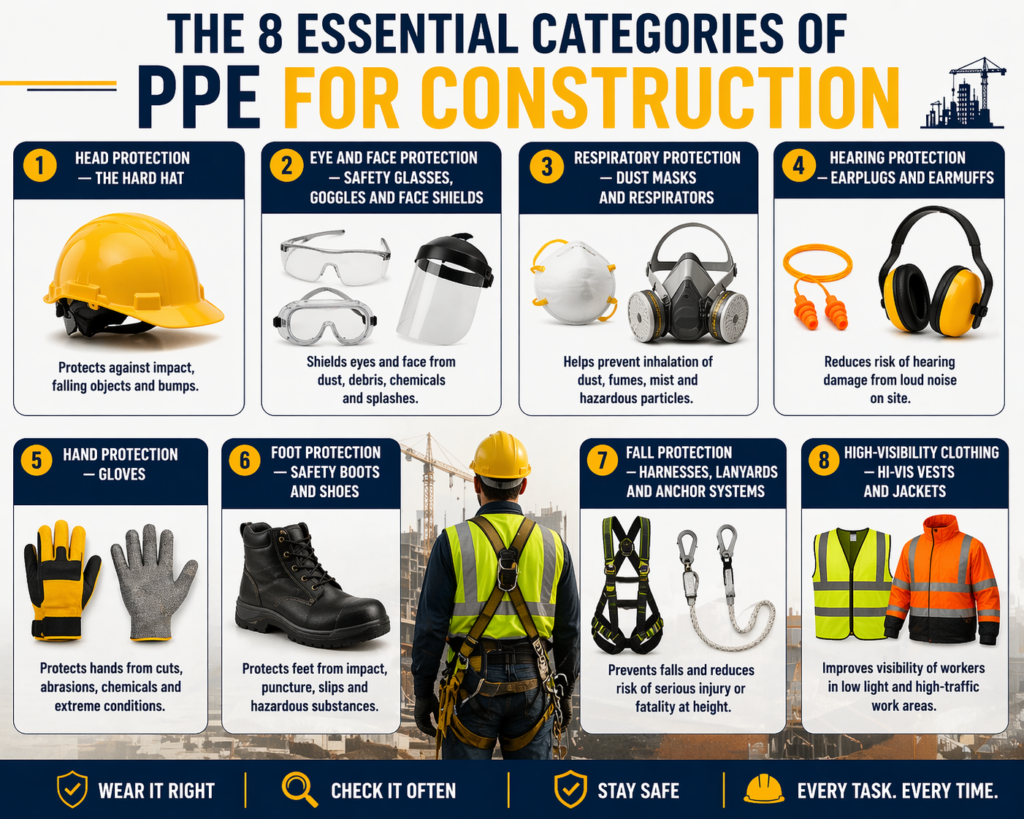
The 8 essential categories of PPE for construction
1. Head protection — the hard hat
The hard hat is the most recognisable symbol of construction safety and for good reason. Falling objects, low overhead beams, protruding rebar, and accidental contact with electrical lines are all real risks on any active construction site.
Types of hard hats:
Hard hats come in two main classes. Class A helmets provide general impact and penetration protection and are the most common on construction sites. Class B helmets offer additional electrical protection and are used when working near live electrical systems. Class C helmets are lightweight and comfortable but offer no electrical protection.
How to wear your hard hat correctly:
A hard hat only protects you if it fits properly. The suspension system inside the helmet — the web of straps — should be adjusted so the hat sits level on your head, roughly two finger-widths above your eyebrows. Never wear a hard hat backwards unless the manufacturer specifically approves reverse wearing for that model. Never place stickers over cracks or damage — inspect your helmet before every use and replace it immediately if you see cracks, dents, or damage to the suspension.
When to replace it: Every 2–5 years depending on manufacturer guidance, or immediately after any significant impact — even if no visible damage is present.
2. Eye and face protection — safety glasses, goggles and face shields
Safety glasses provide basic impact protection against flying particles and debris. They are suitable for general construction tasks like cutting, hammering and drilling.
Safety goggles seal completely around the eyes and are required when there is a risk of liquid splashes, fine dust, or chemical exposure. Goggles are not optional when working with concrete admixtures, epoxy resins, solvents or any hazardous liquid.
Face shields protect the entire face from splatter, sparks and molten metal. They should always be used in combination with safety glasses or goggles underneath — never alone.
Welding helmets provide specialised protection from the extreme UV and infrared radiation produced during welding. Auto-darkening welding helmets are highly recommended as they allow clear vision between welds and automatically darken to the correct shade when the arc starts.
Key rule: The correct eye protection depends on the specific task. A worker cutting tiles needs different protection than a worker applying waterproofing chemicals. Always match the PPE to the hazard.
3. Respiratory protection — dust masks and respirators
India’s construction sites generate enormous amounts of dust — silica dust from concrete and stone cutting, cement dust, wood dust and chemical vapours. Many of these are invisible to the naked eye, and their effects are not felt until years later. Silicosis, asbestosis, occupational asthma and even lung cancer are documented outcomes of chronic unprotected dust exposure.
Disposable dust masks (N95 / FFP2) filter out at least 95% of airborne particles. They are suitable for general dust protection during tasks like cutting, grinding, sanding and demolition. They must fit snugly against the face — a loose mask offers very little real protection. A mask that gaps at the sides is almost useless.
Half-face respirators cover the nose and mouth and use replaceable cartridges. Different cartridges filter different hazards — particulates, organic vapours, acid gases. They are used when working with paints, solvents, adhesives, waterproofing chemicals and similar substances.
Full-face respirators protect both the respiratory system and the eyes simultaneously. They are used in confined spaces, high-dust environments and when working with highly toxic substances.
Critical reminder: Dust masks and respirators must be fit-tested regularly. A poorly fitting respirator provides false confidence, not real protection. Workers with beards should be aware that facial hair prevents a proper seal on most respirators.
4. Hearing protection — earplugs and earmuffs
Construction is one of the noisiest working environments in the world. Prolonged exposure to noise above 85 decibels (dB) causes permanent, irreversible hearing loss. Concrete breakers, angle grinders, generators, compactors and pile drivers routinely produce noise levels of 95–115 dB.
There is no treatment for noise-induced hearing loss. Once it is gone, it is gone.
Disposable foam earplugs are the most widely used form of hearing protection on construction sites. When inserted correctly, they can reduce noise levels by 25–33 dB. Correct insertion is critical — the plug must be rolled thin, inserted deep into the ear canal, and held in place while it expands.
Earmuffs cup over the entire outer ear and provide consistent, easy-to-use protection. They are particularly useful when workers need to remove and replace hearing protection frequently during the day.
When is hearing protection required? On any task or in any area where noise levels exceed 85 dB. Common triggers include operating jackhammers, working near generators, and any work within 10 metres of heavy plant machinery.
5. Hand protection — gloves
The hands are the most used — and most exposed — part of a construction worker’s body. Cuts, abrasions, crush injuries, chemical burns, vibration damage and electrical shock are all common hand hazards.
Different tasks demand different gloves:
- General work gloves (leather or synthetic): for handling materials, carrying steel bars, working with rough surfaces
- Cut-resistant gloves: for handling sheet metal, glass, sharp-edged materials
- Chemical-resistant gloves (nitrile or neoprene): for handling solvents, adhesives, waterproofing products and any hazardous chemicals
- Heat-resistant gloves: for welding and work near hot surfaces
- Anti-vibration gloves: for prolonged use of vibrating tools like angle grinders, jackhammers and compactors
Important: Never wear loose, baggy gloves near rotating machinery or power tools. A loose glove can be caught in the machinery and drag the hand in with it. Use form-fitting gloves, or no gloves at all, near rotating parts.
6. Foot protection — safety boots and shoes
Feet are at constant risk on construction sites from falling objects, sharp materials underfoot, chemical spills, electrical hazards and slippery surfaces. Safety footwear is non-negotiable.
Steel-toed safety boots protect against impact from falling objects. They are the standard requirement on virtually every construction site. Look for footwear marked IS 15298 (Indian Standard) or EN ISO 20345, which certifies that the toe cap can withstand a 200-joule impact.
Puncture-resistant midsoles protect against nails, rebar and sharp objects that can penetrate upward through the sole of the foot. This is critical on sites with significant debris.
Anti-slip soles are essential on wet, muddy, tiled or smooth surfaces. Slips and trips on construction sites are a major cause of serious injury.
Electrical hazard boots provide insulation from electrical shock and are required when working near live electrical systems.
Care and replacement: Inspect safety boots regularly for sole separation, cracked leather, damaged toe caps and worn-out grip. A safety boot that has absorbed a significant impact should be replaced even if there is no visible damage — the toe cap may have deformed internally and will no longer protect effectively.
7. Fall protection — harnesses, lanyards and anchor systems
Falls from height are the single leading cause of fatalities in the construction industry globally. According to the International Labour Organization (ILO), falls account for approximately 38% of all construction deaths. In India, this figure is believed to be even higher due to less consistent enforcement of fall protection requirements.
Fall protection PPE is mandatory whenever a worker is operating at a height of 1.8 metres or more above the ground or a lower level.
Full-body harness: A full-body harness distributes fall arrest forces across the thighs, pelvis, chest and shoulders. This distribution is critical — a simple waist belt or chest harness can cause fatal internal injuries during a fall arrest. Always use a full-body harness for work at height.
Lanyards and shock absorbers: The lanyard connects the harness to an anchor point. Energy-absorbing lanyards contain a deceleration device that slows the fall and limits the peak force transmitted to the body. Never use a lanyard that would allow you to fall more than 1.8 metres before it arrests your fall.
Anchor points: The entire fall protection system is only as strong as its anchor point. Anchor points must be capable of supporting at least 15 kN (approximately 1,500 kg) of force. Never attach to scaffolding guardrails, pipes or anything that has not been designated as a certified anchor point.
Inspection before every use: Check every component — harness webbing for cuts or fraying, stitching for damage, buckles for correct function, and the lanyard for any signs of stretching or deployment. A harness that has arrested a fall must be removed from service immediately, even if it appears undamaged.
8. High-visibility clothing — hi-vis vests and jackets
Being seen is a basic survival requirement on construction sites where heavy plant machinery, vehicles and cranes are in constant operation. High-visibility (hi-vis) clothing ensures that workers are visible to machine operators, vehicle drivers and other site personnel.
Class 1 hi-vis (basic vest): suitable for environments with low traffic and vehicle speeds.
Class 2 hi-vis (vest with reflective strips): required in most construction site environments where vehicles are operating.
Class 3 hi-vis (full jacket with reflective strips on arms and torso): required in high-traffic environments, night work and road construction.
Hi-vis clothing must be kept clean and in good condition — dirty, faded or damaged hi-vis is significantly less effective. Workers on night shifts should always wear Class 3 hi-vis with retroreflective strips.
How to inspect PPE before use
The best PPE in the world is useless if it is damaged. Before every shift, every worker should perform a quick inspection:
- Check for visible cracks, tears, cuts or deformation
- Test all buckles, clips and fasteners for correct function
- Check elastic and webbing for stretching, fraying or discolouration
- Verify that expiry dates have not passed (yes — PPE has expiry dates)
- Ensure the PPE is the correct size and fits the user properly
- Report and replace any damaged or suspect PPE before starting work
Common PPE mistakes on Indian construction sites
Despite clear legal requirements, PPE misuse remains widespread. Here are the most common mistakes observed:
Wearing the wrong size: PPE that does not fit cannot protect. An oversized hard hat that slides over the eyes, or undersized gloves that restrict movement, both reduce protection and increase risk.
Not replacing damaged PPE: Workers often continue using cracked helmets, torn harnesses or worn-out gloves because replacements are not immediately available. This is a management failure, not a worker failure — PPE replacement systems must be in place on every site.
Removing PPE for comfort: Heat and humidity in India make PPE uncomfortable. But comfort is temporary; an injury is permanent. Employers should invest in breathable, climate-appropriate PPE to encourage consistent compliance.
Using non-certified PPE: Cheap, uncertified PPE that does not meet IS or EN standards is abundant in India. It looks identical to certified PPE but may offer almost no real protection. Always verify BIS markings or IS certifications before purchasing.
Storing PPE incorrectly: Ultraviolet light degrades many PPE materials, especially harness webbing and hard hat shells. PPE should be stored away from direct sunlight, heat sources and chemicals when not in use.
Employer responsibilities under Indian law
Under the BOCW Act 1996 and the Factories Act 1948, employers have clear legal obligations regarding PPE:
- Provide appropriate PPE free of cost to all workers
- Ensure PPE meets applicable Indian Standards (BIS/IS certifications)
- Train workers on correct use, fitting, maintenance and storage of all PPE
- Maintain records of PPE issued to each worker
- Replace worn, damaged or expired PPE promptly
- Conduct regular inspections to ensure PPE is being worn correctly
Failure to meet these obligations can result in penalties, prosecution and — most importantly — preventable deaths and injuries.
A quick PPE selection guide by task
| Task | Required PPE |
| General site work | Hard hat, safety boots, hi-vis vest, gloves |
| Working at heights (≥1.8m) | Full-body harness, lanyard, anchor, hard hat |
| Grinding | Hard hat, goggles, N95 mask, hearing protection, heat-resistant gloves, Face shield |
| Welding | Welding helmet with shield, heat-resistant gloves, safety boots, flame-resistant clothing |
| Chemical handling | Chemical-resistant gloves, goggles, half-face respirator, safety boots |
| Demolition | Hard hat, goggles, N95 mask, hearing protection, gloves, safety boots |
| Electrical work | Class B hard hat, electrical hazard boots, insulated gloves |
| Night / traffic work | Class 3 hi-vis jacket, hard hat, safety boots |
Conclusion
PPE is not a burden — it is protection. Every piece of equipment described in this guide exists because someone, somewhere, was seriously injured or killed without it. The standards were written in response to real tragedies.
As a construction worker, supervisor or safety officer, your responsibility is simple: know which PPE is required for each task, wear it correctly every time, inspect it before use, and replace it the moment it shows signs of damage.
On Safety with CK, we cover every aspect of construction and industrial safety in practical, plain-language detail. If this guide helped you, share it with your team — because the most valuable safety tool on any site is knowledge.
Which PPE topic would you like us to cover in more detail? Tell us in the comments below — your suggestion shapes our next article.
Great content! Keep up the good work!
Helpful tips for everyone
Very easy to follow