
In many workplaces, the Hierarchy of Controls in Safety is often overlooked, and safety is judged mainly by visible measures—helmets, gloves, and safety shoes. While these are important, they can create a false sense of security if used as the primary safety strategy. True safety is not about what we wear; it is about how effectively we control hazards at their source.
Organizations that rely heavily on PPE may appear compliant, but the actual risk may still remain unchanged. A strong safety system focuses on eliminating hazards first and using PPE only as a backup layer of protection.
The real question is:
Are we preventing hazards—or just protecting ourselves from them?
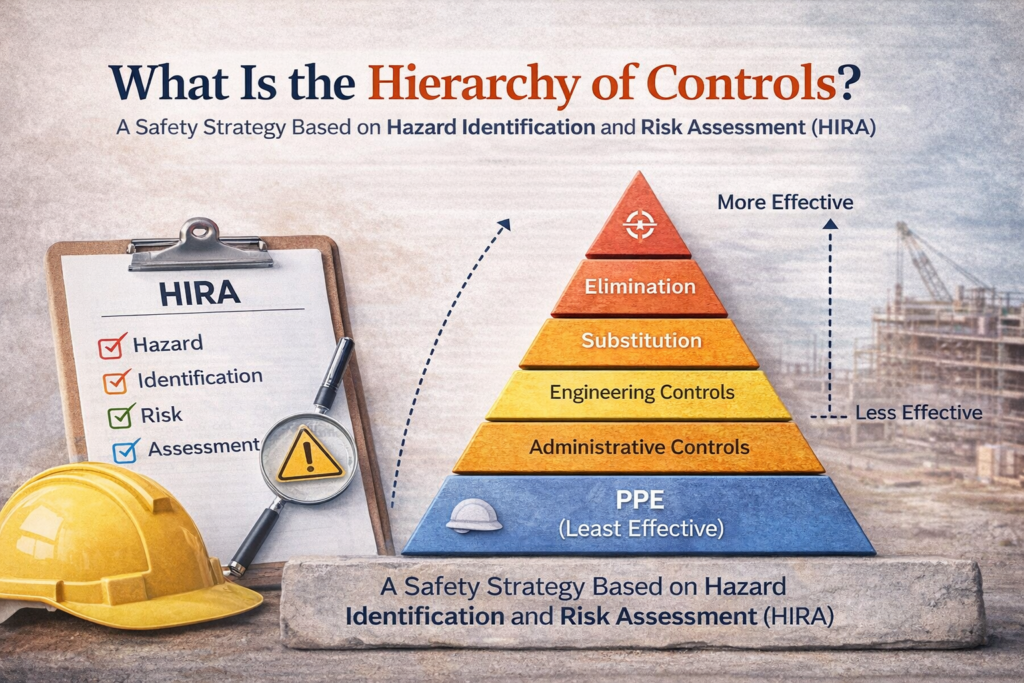
What Is the 5 Hierarchy of Controls?
The Hierarchy of Controls in Safety is a structured approach used to eliminate or reduce workplace hazards by applying control measures in order of effectiveness. Based on findings from Hazard Identification and Risk Assessment (HIRA), this method prioritizes controlling risks at their source before relying on human behavior.
The five levels of Hierarchy of Controls include:
1. Elimination (Most Effective)
Remove the hazard completely from the workplace.
2. Substitution
Replace the hazard with a safer alternative.
3. Engineering Controls
Isolate workers from hazards through design (e.g., guardrails, automation).
4. Administrative Controls
Change work procedures, training, and supervision.
5. PPE – Personal Protective Equipment (Least Effective)
Protect workers using helmets, gloves, goggles, etc.
The lower you go in this list, the less effective the control becomes. This hierarchy clearly shows that PPE is the least reliable control because it depends entirely on human compliance and proper usage.
The Common Mistake: Over-Reliance on PPE
In reality, many organizations spend most of their effort on PPE. Why?
In many organizations, PPE becomes the first response when a hazard is identified. Workers are provided with helmets, gloves, and safety glasses, and the risk is considered controlled. However, the hazard still exists in the workplace.
For example, if work is performed at height, providing a safety harness is important—but it does not remove the risk of fall. Installing guardrails, working platforms, or redesigning the activity to eliminate work at height would be far more effective.
This over-reliance on PPE happens because:
- PPE is easy to distribute
- Compliance is easy to monitor
- It shows immediate action
- It requires less planning
- It is perceived as cost-effective
But here’s the truth:
PPE does not eliminate risk—it only reduces injury after an incident occurs.
Why PPE Is the Least Effective Hierarchy of Controls
PPE is essential, but it has several limitations that make it the weakest control in the hierarchy.
- PPE depends on worker behavior
- It may be worn incorrectly
- It can be removed during work
- It may not fit properly
- It requires regular inspection and replacement
- It does not eliminate hazards
For instance:
- Helmets reduce head injury but do not prevent falling objects
- Gloves protect hands but do not remove sharp edges
- Safety shoes reduce foot injury but do not stop heavy materials from falling
- Goggles protect eyes but do not eliminate flying particles
This is why PPE should always be treated as the last layer of protection, not the primary safety control.
Shift from Reaction to Prevention
A proactive safety culture focuses on prevention instead of reaction. The goal should be to remove hazards before work begins rather than depending on PPE after exposure.
Organizations can shift toward prevention by:
- Designing safer work methods
- Using automation where possible
- Installing permanent safety systems
- Reducing manual handling
- Improving equipment design
- Eliminating unnecessary exposure
For example:
- Use prefabrication at ground level instead of working at height
- Install machine guards instead of only providing gloves
- Use barricades instead of only warning signs
- Provide fixed platforms instead of ladders
- Use lifting tools instead of manual handling
These controls reduce dependency on human behavior and improve safety performance.
Practical Example from Construction Site
Consider material lifting activity at site:
PPE Approach (Least Effective)
Workers wear helmets and safety shoes.
Administrative Control
Supervisor monitors lifting activity.
Engineering Control
Use lifting beam, tag line, and barricading.
Substitution
Use smaller pre-fabricated components.
Elimination (Most Effective)
Avoid lifting by assembling at ground level.
This example clearly shows how higher-level controls significantly reduce risk.
Benefits of Using Higher-Level Hierarchy of Controls
When organizations focus on elimination and engineering controls, they gain multiple benefits:
- Reduced accidents and injuries
- Improved productivity
- Less dependency on supervision
- Lower long-term cost
- Stronger safety culture
- Better worker confidence
- Improved compliance with safety standards
Higher-level controls are more sustainable and reliable compared to PPE-based safety.
Key Question to Ask Before Starting Work
Before starting any task, ask:
Are we eliminating the hazard, controlling it, or just depending on PPE?
This simple question helps teams move toward stronger safety decisions and better risk management.
Final Thought
PPE is important, but it should never be the starting point for safety. The Hierarchy of Controls in Safety reminds us that the most effective safety systems eliminate hazards rather than managing injuries.
Real safety begins when we focus on prevention, not protection. Most workplaces spend 80% of their effort on controls that contribute only 10% to actual safety. Safety is not just about wearing protection—it’s about eliminating danger at its source.
The stronger the controls at the top of the hierarchy, the less we need to rely on PPE at the bottom.
When we move beyond PPE and focus on smarter controls, we don’t just reduce injuries—we create truly safe workplaces.
Pingback: Ultimate Guide to PPE: The 8 essential categories of PPE for construction