
Every year, 14th April is observed as National Fire Service Day, followed by National Fire Service Week from 14th to 20th April across India. This important observance is dedicated to honoring the sacrifice of brave firefighters and spreading awareness about fire prevention, preparedness, and emergency response.
Fire incidents can occur without warning and escalate rapidly, causing loss of life, property damage, and operational disruption. National Fire Service Week serves as a reminder that fire safety is not limited to firefighters — it is everyone’s responsibility. This week encourages workplaces, institutions, and communities to review safety measures, educate people, and strengthen emergency preparedness.
The History Behind National Fire Service Week
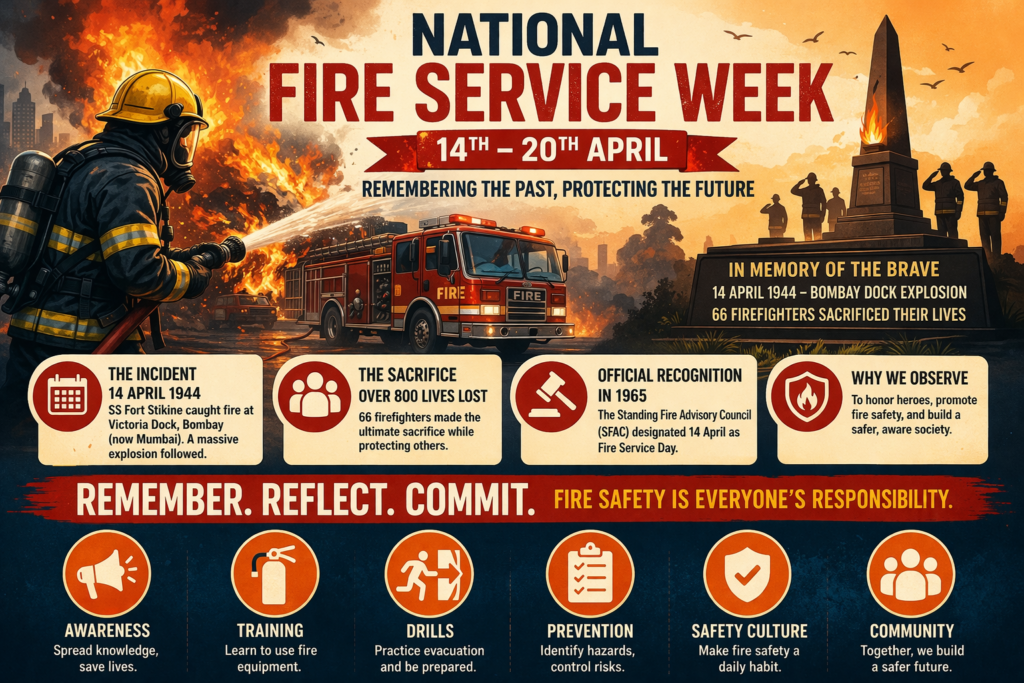
National Fire Service Day is observed in memory of the tragic Bombay Dock Explosion that occurred on 14th April 1944 at Victoria Dock, Bombay (now Mumbai). On that day, a cargo ship named SS Fort Stikine caught fire while docked at the port. The ship was carrying a dangerous combination of explosives, ammunition, cotton bales, and other flammable materials.
When the fire broke out, firefighters rushed to the scene to control the blaze and prevent further damage. Despite knowing the risk, they continued firefighting operations. Unfortunately, the situation worsened and resulted in a massive explosion.
The explosion caused:
- Widespread destruction in surrounding areas
- Heavy damage to port infrastructure
- Fire spreading to nearby ships and buildings
- Panic and chaos across the city
During this tragic incident:
- Over 800 lives were lost
- 66 fire service personnel sacrificed their lives in the line of duty
- Hundreds of people were injured
- The fire burned for several hours
This incident remains one of the worst fire disasters in India’s history. The courage and sacrifice shown by firefighters became the foundation for observing National Fire Service Week.
Later, in 1965, the Standing Fire Advisory Council (SFAC) officially designated 14th April as Fire Service Day, followed by National Fire Service Week (14–20 April) to promote fire safety awareness across the country.
National Fire Service Week Theme 2026
This year’s National Fire Service Week theme, “Safe School, Safe Hospital & Fire Safety Aware Society – Together for Fire Prevention,” highlights the importance of protecting places where safety is most critical. Schools and hospitals are high-occupancy buildings where emergencies can quickly turn into serious situations if proper fire safety measures are not in place.
The theme focuses on building awareness not only in industries but also in public institutions and communities. Schools have children who may not be fully aware of emergency procedures, while hospitals accommodate patients who may not be able to evacuate quickly. These environments require stronger fire prevention planning, trained staff, and reliable emergency systems.
Creating safer schools means ensuring that:
- Emergency exits are clearly marked and unobstructed
- Fire extinguishers are available and maintained
- Teachers and staff are trained in evacuation procedures
- Fire drills are conducted regularly
- Electrical systems are safe and not overloaded
- Assembly points are identified
Students should also be educated about basic fire safety. Simple awareness like not playing with fire, understanding alarm sounds, and following teacher instructions during evacuation can save lives.
Similarly, hospitals require even more detailed fire safety planning. Patients in hospitals may be bedridden, under treatment, or dependent on medical equipment. In such situations, evacuation becomes challenging and requires trained personnel.
Hospitals should focus on:
- Fire detection and alarm systems
- Clear evacuation routes
- Staff training for emergency response
- Fire-resistant storage for oxygen cylinders
- Electrical load management
- Emergency lighting systems
- Regular mock drills
The theme also emphasizes building a fire safety aware society. Fire prevention should not be limited to workplaces. Communities, residential buildings, schools, hospitals, and public places must all participate in fire safety awareness.
This can be achieved through:
- Public awareness campaigns
- Fire safety demonstrations
- Community training programs
- School safety education
- Mock drills in public places
- Awareness posters and banners
When people understand fire risks and know how to respond, the chances of major incidents reduce significantly.
Why We Celebrate National Fire Service Week
The main objective of National Fire Service Week is to create awareness about fire hazards and promote preventive measures. Most fire incidents occur due to negligence, poor maintenance, lack of awareness, and unsafe practices. Through awareness campaigns, training, and inspections, organizations can significantly reduce fire risk.
This week focuses on:
- Fire prevention awareness
- Emergency preparedness
- Fire extinguisher training
- Evacuation planning
- Equipment inspection
- Community participation
- Honoring firefighters
It also encourages organizations to review their fire safety systems and ensure readiness for emergencies.
Importance of Fire Safety Awareness
Fire spreads quickly and leaves very little time to react. In many emergencies, panic and confusion increase the severity of the situation. Proper awareness helps individuals respond quickly and safely.
Fire safety awareness helps people:
- Identify fire hazards
- Understand emergency procedures
- Use fire extinguishers
- Evacuate safely
- Avoid panic
- Help others during emergencies
Training and awareness can save lives and minimize damage.
Common Causes of Fire Incidents
Understanding the causes of fire is the first step toward prevention. Some common causes include:
Electrical Short Circuit
Loose wiring, overloaded circuits, and damaged cables can generate sparks and cause fire.
Hot Work Activities
Welding, gas cutting, and grinding produce sparks that may ignite nearby combustible materials.
Improper Storage of Flammable Materials
Diesel, LPG cylinders, paints, and chemicals stored without precautions create fire hazards.
Poor Housekeeping
Accumulated combustible waste like paper, wood, cloth, and packaging increases risk of fire at workplace.
Smoking in Unauthorized Areas
Smoking near flammable substances is a major cause of workplace fires.
Equipment Overheating
Poorly maintained machinery can overheat and ignite surrounding materials.
Activities Conducted During Fire Service Week
National Fire Service Week should be observed with active participation and meaningful safety initiatives. Organizations can conduct:
Public Awareness Campaigns
Educate employees, workers, and communities about fire hazards and prevention methods.
Demonstrations and Fire Drills
Conduct live demonstrations on using fire extinguishers and emergency evacuation drills.
Fire Safety Training
Provide training on fire classes, extinguisher types, and emergency response.
Essay and Slogan Competitions
Encourage participation from employees, students, and communities to spread awareness.
Industrial Safety Focus
Inspect workplaces and ensure fire prevention measures are implemented.
Fire Equipment Inspection
Check:
- Fire extinguishers
- Fire hydrants
- Hose reels
- Alarm systems
- Emergency lighting
These activities help strengthen emergency preparedness.
Fire Prevention Measures Everyone Should Follow
Fire prevention starts with simple but disciplined practices:
- Maintain good housekeeping
- Avoid overloading electrical circuits
- Store flammable materials safely
- Follow hot work permit system
- Keep fire extinguishers accessible
- Do not block emergency exits
- Avoid smoking in restricted areas
- Report unsafe conditions immediately
These small steps significantly reduce fire risk.
Emergency Response During Fire
If fire occurs, follow these steps:
- Raise alarm immediately
- Inform emergency response team
- Use fire extinguisher if trained
- Evacuate calmly
- Do not use lifts
- Follow marked escape routes
- Assemble at designated point
- Do not panic
Preparedness saves lives.
Role of Organizations
Organizations should:
- Conduct fire safety training
- Arrange mock drills
- Maintain fire systems
- Display emergency plans
- Appoint fire wardens
- Review evacuation routes
A proactive approach reduces fire incidents.
Role of Individuals
Every individual should:
- Know emergency exits
- Participate in drills
- Report hazards
- Maintain housekeeping
- Follow safety rules
- Stay calm during emergencies
Fire safety is a shared responsibility.
Conclusion
National Fire Service Week, observed from 14th April to 20th April, is a reminder of the tragic Bombay Dock Explosion of 1944 and the sacrifice of 66 brave firefighters who lost their lives while protecting others. It also highlights the need for awareness, preparedness, and prevention.
Fire does not give warning, but preparedness saves lives. By promoting fire safety awareness, conducting drills, maintaining equipment, and encouraging safe practices, we can create safer workplaces and communities.
Let us observe this National Fire Service Week with commitment and spread the message:
Remember, Reflect, and Commit — Fire Safety is Everyone’s Responsibility.